


Lessons from the Irish Potato Famine

Updated: Jul 18, 2025
The Irish potato famine resulted from genetic uniformity, exploitative land tenure, British economic policies, extreme poverty, population pressure, adverse weather, inadequate relief, and rampant disease.
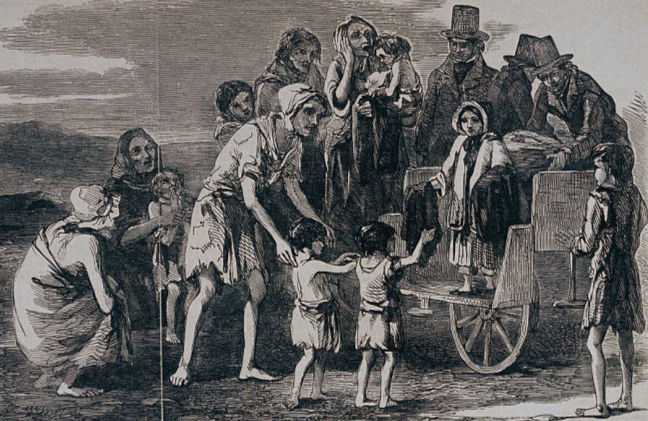
Lesson #1 Genetic Uniformity makes crops vulnerable to blight. Genetically modified is a pejorative word today. Non GMO is cool, right ? In the aftermath of the blight, other species of potato were cross-bred (early GMO) to reduce the vulnerability to the fungus/blight. In today's world, genes can be spliced in to the tuber to help it fight off the diseases that ravaged Ireland almost 200 years ago. It's a discussion that takes thought and not just screaming.
Lesson # 2 The Malthusians have always been wrong
The Failure of Malthusian Theory and Its Legacy of Cruelty
Thomas Robert Malthus submitted in his 1798 essay An Essay on the Principle of Population that population growth would inevitably outstrip food supply, resulting in famine, disease, and social collapse. This bleak forecast gave rise to a worldview rooted in scarcity, which has often served as a justification for cruel policies. But here we are over two centuries later. History has thoroughly discredited Malthusian predictions. Roughly three percent of the US population works to feed the other 97%. The US long ago transformed from an agricultural society.
Malthus failed to anticipate human innovation. From mechanized farming to synthetic fertilizers, humans have repeatedly overcome supposed natural limits through ingenuity. Malthus’s core error was assuming food supply as linear; he assumed population growth to grow exponentially.
More than just an intellectual mistake, Malthusian thinking has repeatedly served as a moral cover for inequality and neglect. In the 19th century, British officials used ostensiby Malthusian logic to justify minimal intervention during famines in Ireland and India, blaming the victims for overpopulation rather than providing aid. The result was mass death that could have been prevented ( Ireland's population has never really recovered ).
Throughout history, elites have found Malthusianism a convenient tool: it transforms poverty from a solvable political problem into an inevitable natural disaster, absolving those in power of responsibility.
In the 20th century, Malthusian fears cropped up with the rise of environmentalism. Books like Paul Ehrlich’s The Population Bomb (1968) predicted catastrophic famines due to overpopulation. These predictions proved spectacularly wrong. Global food production per capita has increased even as population has grown. Yet Malthusian alarmism inspired coercive population control programs — many of which involved forced sterilizations and human rights violations, disproportionately targeting poor and marginalized communities.
The main reason for famine in Africa is interdiction of food supply. It is not far fetched to predict that someday subsurface membranes will result in independence for now impoverished peoples.
Even today, Malthusianism persists in disguised forms. Climate change debates sometimes flirt with neo-Malthusian ideas, suggesting that reducing human population is the key to environmental salvation. This thinking shifts focus from reforming unsustainable systems to blaming the existence of the poor.
Ultimately, Malthusianism is not just empirically wrong—it is morally corrosive. It presumes scarcity where abundance is possible, and uses that false scarcity to justify withholding aid. It treats human beings as burdens rather than agents of creativity and change.


Comments